

An academic paper, market analysis, or technical report is only as reliable as the evidence behind it. General search engines can help you get started, but peer reviewed studies and original datasets can be hard to find among blog posts and summaries. Knowing which research websites to use can save you time, whether you’re conducting a systematic literature review, checking the reported results of a clinical trial, or looking for industry statistics.
Scholarly platforms give students, researchers, and analysts access to millions of records, including journal articles, openly available preprints, dissertations, and datasets they can reuse. A directory of specialized databases and broader repositories helps you find original sources and check whether they support the claims in your work. The selection below includes digital libraries, citation indexes, and open science platforms to help you go from finding your first source to compiling your final bibliography.
The Complete List of 30 Research Websites
Below, we have gathered 30 reliable research websites spanning multidisciplinary citation indexes, biomedical archives, preprint servers, and open-access data repositories.
Top Research Websites for Scholarly Articles, Data, and Citations
- 1. Google Scholar – A freely accessible web search engine that indexes the full text and metadata of scholarly literature across an array of publishing formats and disciplines.
- 2. Statista – A global data and business intelligence platform providing curated statistics, market reports, and consumer survey findings across hundreds of industries.
- 3. PubMed – A free biomedical and life sciences search engine maintained by the National Center for Biotechnology Information containing millions of MEDLINE citations and abstracts.
- 4. JSTOR – A digital library offering digitized back issues of academic journals, books, and primary sources across the humanities, social sciences, and sciences.
- 5. ScienceDirect – Elsevier’s leading platform of peer-reviewed scholarly literature featuring thousands of scientific, technical, and medical journals and e-books.
- 6. Scopus – A comprehensive abstract and citation database covering peer-reviewed literature across scientific, technical, medical, and social science fields.
- 7. Web of Science – A multidisciplinary citation indexing service providing access to multiple databases that reference cross-disciplinary research and impact metrics.
- 8. IEEE Xplore – A digital research database providing full-text access to technical literature in electrical engineering, computer science, and electronics.
- 9. DOAJ – The Directory of Open Access Journals, an independent online index of diverse, peer-reviewed, open-access scholarly journals from around the world.
- 10. ERIC – The Education Resources Information Center, an online digital library of education research and information sponsored by the U.S. Department of Education.
- 11. PubMed Central – A free full-text archive of biomedical and life sciences journal literature at the U.S. National Institutes of Health’s National Library of Medicine.
- 12. ResearchGate – A commercial social networking site for scientists and researchers to share papers, ask and answer questions, and find collaborators.
- 13. Academia.edu – A platform for academics and independent researchers to share research papers, monitor deep analytics on their impact, and follow emerging topics.
- 14. WorldCat – The world’s largest library catalog network connecting users to books, theses, digital media, and archival collections across thousands of member libraries.
- 15. OpenAlex – A fully open catalog of the global research system indexing hundreds of millions of scholarly works, authors, institutions, and venues.

More Research Websites for Preprints, Clinical Trials, and Open Data
- 16. CrossRef – An official Digital Object Identifier registration agency that links millions of scholarly publications through persistent metadata and citation networks.
- 17. Project MUSE – A leading provider of digital humanities and social science content featuring peer-reviewed journals and electronic books from university presses.
- 18. SSRN – The Social Science Research Network, a repository devoted to the rapid dissemination of early-stage scholarly research and working papers across disciplines.
- 19. PhilPapers – A comprehensive index and bibliography of philosophy maintained by the community of philosophers, indexing journal articles, books, and open-access archives.
- 20. SpringerLink – Springer Nature’s integrated online platform providing researchers with access to millions of scientific documents from journals, books, series, and reference works.
- 21. arXiv – An open-access distribution service and preprint archive for scholarly articles in physics, mathematics, computer science, quantitative biology, and statistics.
- 22. Cochrane Library – A collection of databases in medicine and healthcare specialties containing high-quality, independent systematic reviews and clinical evidence.
- 23. ClinicalTrials.gov – A public registry and results database of privately and publicly funded clinical studies conducted around the world.
- 24. ProQuest Dissertations & Theses Global – The world’s most comprehensive curated collection of multi-disciplinary doctoral dissertations and master’s theses from thousands of universities.
- 25. Zenodo – A general-purpose open repository developed under CERN that allows researchers to deposit datasets, software, reports, and other research-related digital artifacts.
- 26. Figshare – An online open-access repository where researchers can preserve and share figures, datasets, images, and videos in a citable, discoverable format.
- 27. Dryad – A curated general-purpose repository that makes the underlying data associated with scientific publications discoverable, freely reusable, and citable.
- 28. Open Science Framework – A free, open-source project management tool and repository that supports researchers throughout the entire study lifecycle and integrates with external storage services.
- 29. CORE – An aggregator collecting millions of open-access research papers from repositories and journals worldwide into a single searchable resource.
- 30. Harvard Dataverse – A free data repository open to all researchers worldwide for sharing, citing, exploring, and analyzing primary research datasets.
Bookmarking a strong combination of these research websites ensures you always know where to look for authoritative evidence, no matter your field of study. Start your literature review on broad discovery indexes like Google Scholar or OpenAlex, dive into specialized archives such as PubMed or IEEE Xplore for domain-specific rigor, and turn to repositories like Zenodo or Harvard Dataverse when you need raw datasets to verify or expand existing findings. Having these platforms at your fingertips will elevate the depth, credibility, and efficiency of every project you undertake.
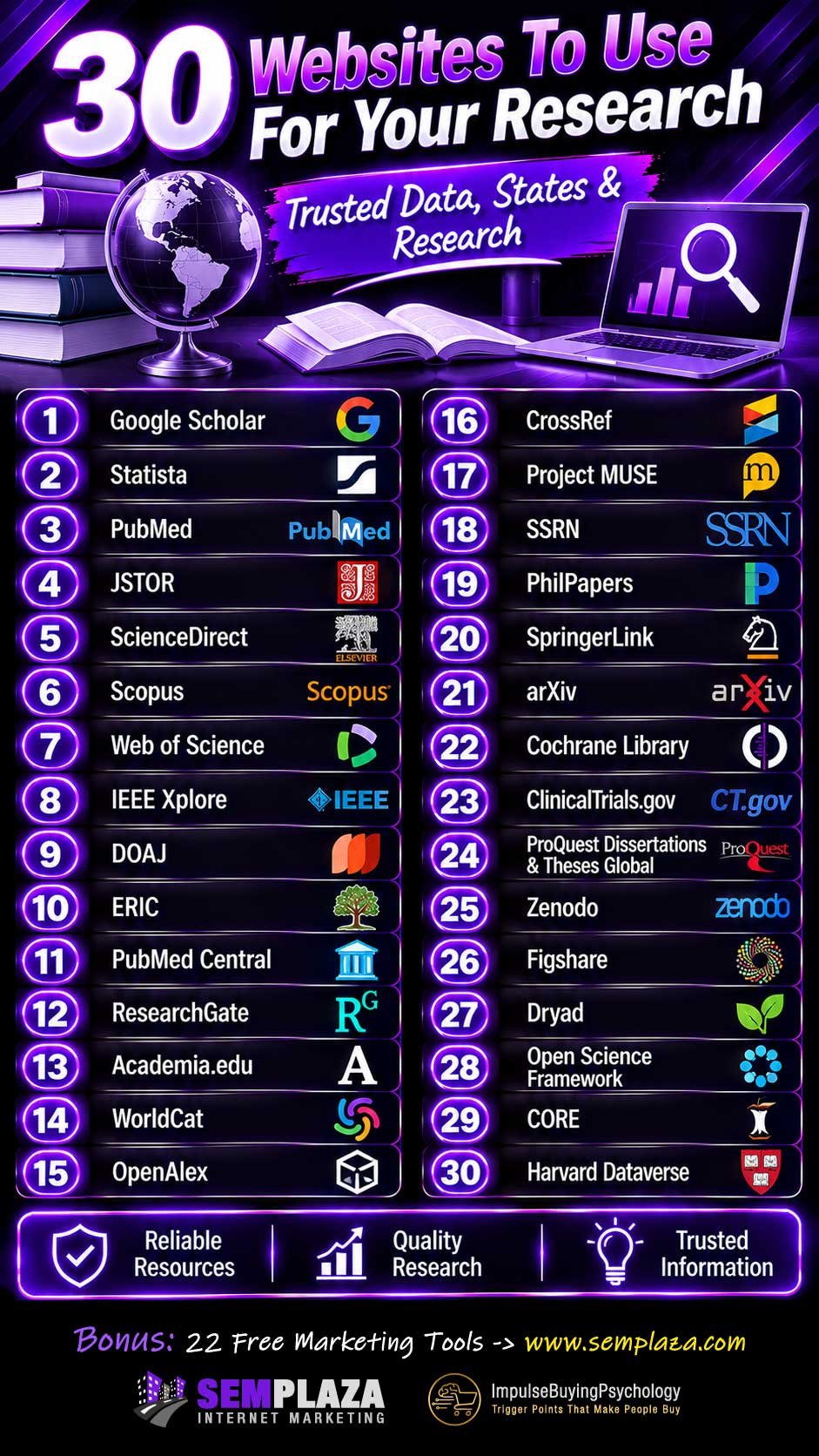
Share this infographic on your site:

Gabi is the founder and CEO of Adurbs Networks, a digital marketing company he started in 2016 after years of building web projects.
Beginning as a web designer, he quickly expanded into full-spectrum digital marketing, working on email marketing, SEO, social media, PPC, and affiliate marketing.
Known for a practical, no-fluff approach, Gabi is an expert in PPC Advertising and Amazon Sponsored Ads, helping brands refine campaigns, boost ROI, and stay competitive. He’s also managed affiliate programs from both sides, giving him deep insight into performance marketing.