
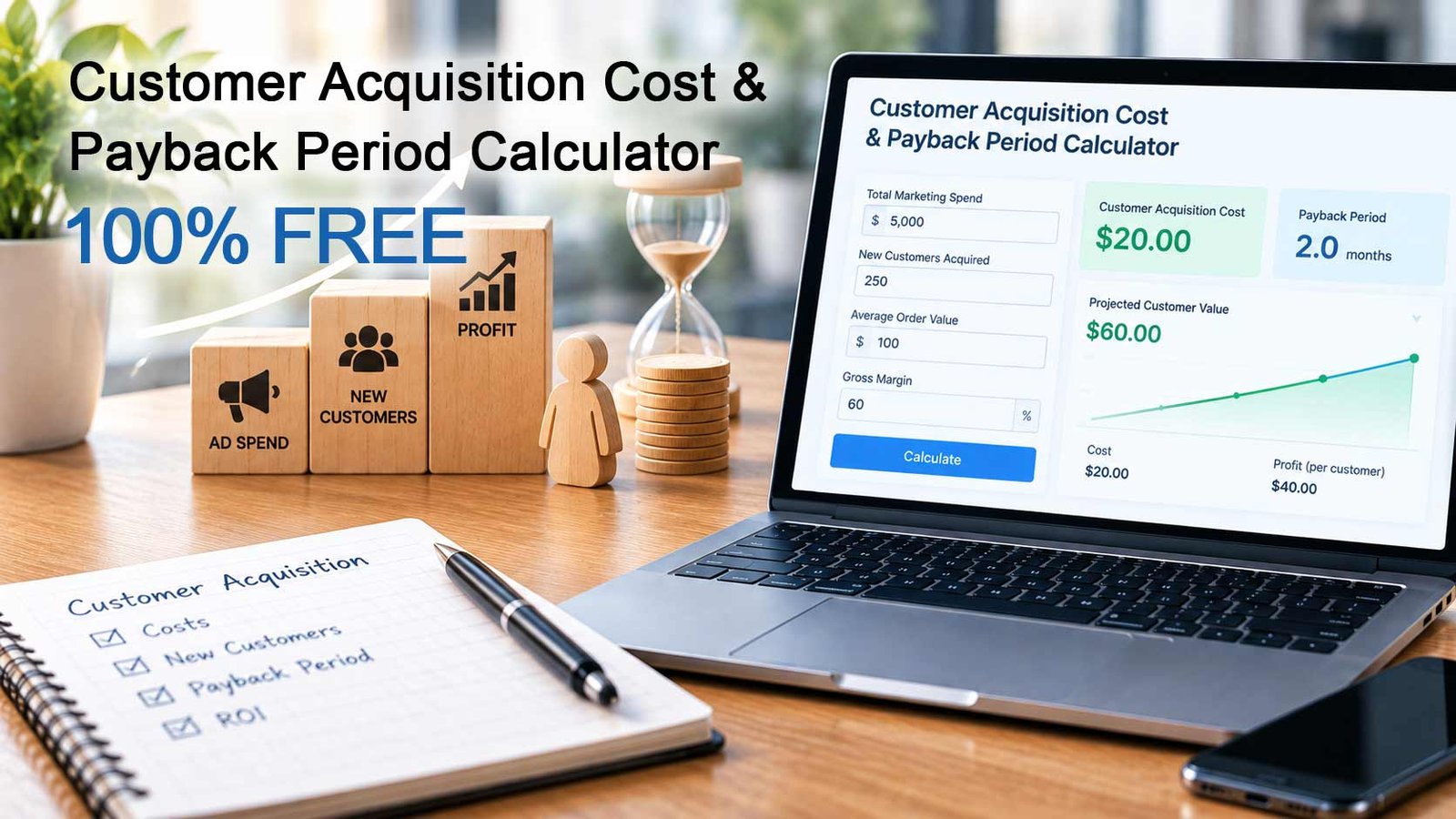
As a seller or business owner, understanding how much you spend to win a new buyer—and how long it takes to recover that investment—is critical for sustainable growth. Without knowing these metrics, you risk burning through capital on unprofitable marketing campaigns or scaling too fast before your unit economics make sense.
Our free Customer Acquisition Cost (CAC) & Payback Period Calculator is designed to help you instantly analyze your sales efficiency, forecast your break-even point, and make smarter budgeting decisions.
What Does the Calculator Do?
This calculator bridges the gap between marketing spend and financial return. By taking your overall sales and marketing outlays and weighing them against your customer volume and profit margins, it instantly calculates two vital metrics:
- Customer Acquisition Cost (CAC): The exact average cost required to acquire a single new paying customer.
- Payback Period: The total number of months it takes for a customer’s cumulative gross profit to completely pay back their acquisition cost.
Who Is This Calculator Targeted To?
This tool is specifically built for:
- E-commerce and DTC (Direct-to-Consumer) Sellers: Looking to manage paid advertising budgets against average order values and retention.
- B2B and SaaS Founders: Tracking sales rep salaries, ad spend, and monthly recurring revenue (MRR) payback timelines.
- Agency Owners and Marketers: Demonstrating campaign efficiency and client profitability.
- Startup Entrepreneurs: Pitching business models or monitoring cash flow burn rates.
How to Use the Calculator
Using the calculator is quick and straightforward. Simply adjust the interactive sliders or type your exact numbers into the input fields:
1. Total sales and marketing expenses
Enter your total aggregate investment over a specific period (e.g., monthly spend on ads, tools, payroll, and agency fees).
2. New customers acquired
Use the slider to input the total number of new customers gained during that same period.
3. Average Revenue Per User (ARPU / mo)
Enter the average monthly revenue generated per customer.
4. Gross margin percentage
Use the slider to set your gross margin percentage, representing the profit left after subtracting direct costs of goods sold or service delivery.
As you change any value, the Estimated Results and Calculation Breakdown update automatically in real-time.
Field Breakdown: What Each Input Represents
- Total Sales and Marketing Expenses: The complete cash investment put into growth. This includes paid advertising (Google, Meta, etc.), sales commissions, marketing software, and team salaries tied to acquisition.
- New Customers Acquired: The count of unique paying customers successfully closed during your measurement timeframe.
- Average Revenue Per User (ARPU): The top-line revenue a single customer brings into your business on a monthly basis.
- Gross Margin Percentage: The share of revenue remaining after covering direct operational or product delivery costs. This ensures your payback period calculation is based on actual profit rather than raw top-line revenue.
How the Calculations Are Made
To maintain complete transparency, the calculator relies on straightforward, industry-standard formulas:
Customer Acquisition Cost (CAC) Formula
To find out how much each customer costs, the total sales and marketing expenses are divided by the number of new customers acquired: CAC = Total Sales and Marketing Expenses divided by New Customers Acquired
Monthly Gross Profit Per Customer Formula
Before measuring payback, the tool calculates how much actual profit a customer generates each month by applying your gross margin to their monthly revenue: Monthly Profit Per Customer = Average Revenue Per User multiplied by Gross Margin Percentage
Payback Period Formula
To determine how long it takes to break even, the acquisition cost is divided by the monthly gross profit generated by that customer: Payback Period (Months) = Customer Acquisition Cost divided by Monthly Profit Per Customer

Gabi is the founder and CEO of Adurbs Networks, a digital marketing company he started in 2016 after years of building web projects.
Beginning as a web designer, he quickly expanded into full-spectrum digital marketing, working on email marketing, SEO, social media, PPC, and affiliate marketing.
Known for a practical, no-fluff approach, Gabi is an expert in PPC Advertising and Amazon Sponsored Ads, helping brands refine campaigns, boost ROI, and stay competitive. He’s also managed affiliate programs from both sides, giving him deep insight into performance marketing.