
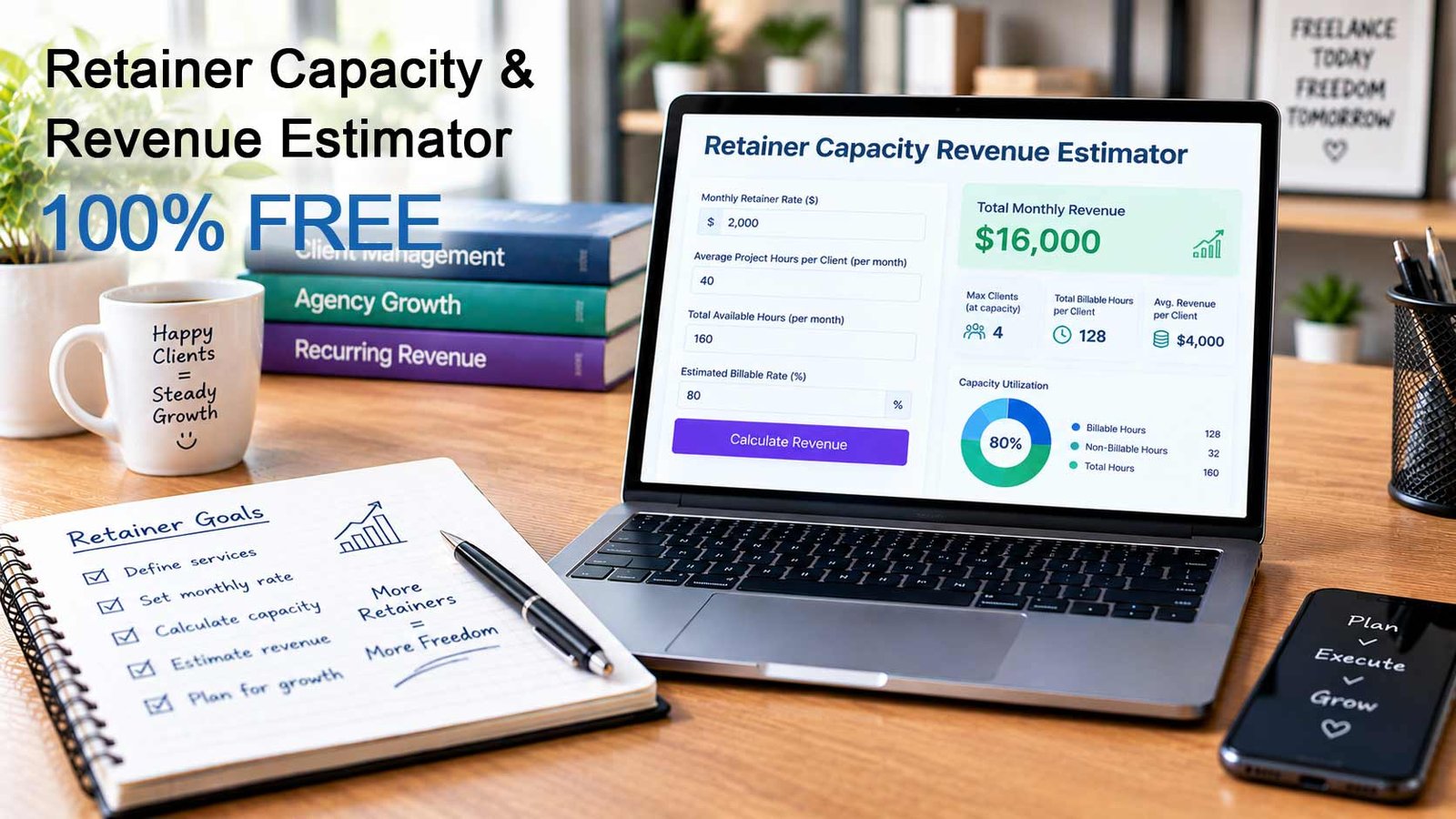
Running an agency on retainers is a balancing act. Sell too little and your team sits idle. Sell too much, or let clients take more hours than they pay for, and quality drops while profit disappears. The Retainer Capacity & Revenue Estimator shows where you stand by comparing your team’s billable hours with the hours your retainers actually consume.
What Is the Retainer Capacity & Revenue Estimator?
The Retainer Capacity & Revenue Estimator is a free online calculator that maps your available billable hours against your client retainer scopes. In seconds it estimates your team’s monthly capacity, your current retainer revenue, the maximum revenue you could earn at full capacity, and how many hours you give away through over-servicing. You can use it to avoid both over-servicing and under-billing, and to plan hiring and sales with real numbers.
Who Is This Calculator For?
The estimator is built for agencies that sell monthly retainers or recurring service packages, including:
- SEO, PPC, social media and content marketing agencies
- Web design and development studios
- PR, branding and creative agencies
- Freelancers who are growing into a small team
- Agency owners, account directors, operations managers and finance leads
How to Use the Retainer Capacity & Revenue Estimator
- Enter your team size, working hours and target utilization to define your capacity.
- Enter your number of retainer clients, the hours each retainer includes and the hours you actually spend.
- Add your average monthly retainer fee and your target hourly rate.
- Read the estimated results and the calculation breakdown, which update instantly as you move any slider or change any value.
- Test scenarios, such as raising your fee, reducing actual hours per client or adding team members, to see how each change affects your numbers.
All fields start at zero, so the calculator only shows results once you add your own data.
What Each Input Field Means
Billable team members: The number of people whose time is sold to clients, such as strategists, designers, developers and account managers. Leave out staff who do not bill time.
Working hours per person per month: The hours each billable person works in a month. A full-time employee typically works around 140 to 160 hours.
Target billable utilization: The share of working hours you aim to spend on client work. The rest goes to meetings, admin, training, sales and time off. Many agencies target between 60 and 80 percent.
Active retainer clients: The number of clients currently paying you a monthly retainer.
Scoped hours per retainer per month: The average number of hours each retainer is meant to include according to your contracts or proposals.
Actual hours worked per retainer per month: The average number of hours your team really spends on each retainer. If this is higher than the scoped hours, you are over-servicing.
Average monthly retainer fee: The average amount a client pays you each month.
Target hourly rate: The rate you want to earn for each billable hour. It is used to estimate your maximum revenue and the value of over-serviced hours.
Understanding the Results
Billable capacity: The total billable hours your team can deliver each month.
Current retainer revenue: What your retainers bring in each month.
Maximum revenue at capacity: What your team could earn if every billable hour were sold at your target hourly rate.
Revenue headroom: The difference between maximum revenue and current revenue. A positive number means you are under-billing relative to your capacity and rate. A negative number means your current revenue is above what your capacity and target rate would produce.
Calculation breakdown: This section shows the details behind the headline numbers: scoped and actual hours, scope load, capacity utilization, remaining capacity, additional retainers you can take on, over-serviced hours and their value, billed rate per scoped hour, effective hourly rate and an overall capacity status.
Capacity status: The status is Over capacity when actual hours exceed your capacity, Under-utilized when capacity utilization is below 70 percent, and Healthy in every other case.
How the Calculator Works: All Formulas
Here are the formulas used, written in plain text so you can reuse them anywhere.
Billable Capacity = Team Members multiplied by Working Hours per Person multiplied by Target Utilization, divided by 100
Scoped Hours Committed = Retainer Clients multiplied by Scoped Hours per Retainer
Actual Hours Worked = Retainer Clients multiplied by Actual Hours per Retainer
Current Retainer Revenue = Retainer Clients multiplied by Average Monthly Retainer Fee
Maximum Revenue at Capacity = Billable Capacity multiplied by Target Hourly Rate
Revenue Headroom = Maximum Revenue at Capacity minus Current Retainer Revenue
Scope Load = Scoped Hours Committed divided by Billable Capacity, multiplied by 100
Capacity Utilization = Actual Hours Worked divided by Billable Capacity, multiplied by 100
Remaining Capacity = Billable Capacity minus Actual Hours Worked
Additional Retainers You Can Take On = Remaining Capacity divided by Actual Hours per Retainer, rounded down to a whole number. If Actual Hours per Retainer is zero, Scoped Hours per Retainer is used instead. If Remaining Capacity is zero or negative, the result is zero.
Over-Serviced Hours = Retainer Clients multiplied by the amount by which Actual Hours per Retainer exceeds Scoped Hours per Retainer. If actual hours are not higher than scoped hours, the result is zero.
Value of Over-Serviced Hours = Over-Serviced Hours multiplied by Target Hourly Rate
Billed Rate per Scoped Hour = Current Retainer Revenue divided by Scoped Hours Committed
Effective Hourly Rate = Current Retainer Revenue divided by Actual Hours Worked
If a divisor is zero, the calculator shows zero instead of an error.
Example
An agency has 5 billable team members who each work 140 hours a month at 75 percent target utilization. It has 20 retainer clients. Each retainer is scoped at 20 hours but takes 24 hours in practice. The average fee is 3,000 dollars and the target hourly rate is 125 dollars.
- Billable capacity: 525 hours
- Current retainer revenue: 60,000 dollars
- Maximum revenue at capacity: 65,625 dollars
- Revenue headroom: 5,625 dollars
- Scope load: 76.2 percent
- Capacity utilization: 91.4 percent
- Over-serviced hours: 80 hours per month, worth 10,000 dollars at the target rate
- Billed rate per scoped hour: 150 dollars
- Effective hourly rate: 125 dollars
The agency is healthy on paper, but 80 hours a month go beyond what clients pay for, and there is room for only one more retainer. Tightening scope or raising fees would improve the numbers.
How to Use Your Results
- Over-servicing is high: Review your scopes, add clear deliverable limits and charge for extra work.
- Effective hourly rate is below target: Raise retainer fees at renewal or reduce the hours spent per client.
- Utilization is low: You have spare capacity, so focus on sales or upsells before hiring.
- Over capacity: Pause new clients, adjust scopes or add team members before quality suffers.
Limitations
The calculator uses averages across all clients, so agencies with very different retainer sizes will get a rougher estimate. It does not include salaries, overheads, taxes, software costs or other expenses. Use the results as a planning guide, not as a financial guarantee.

Gabi is the founder and CEO of Adurbs Networks, a digital marketing company he started in 2016 after years of building web projects.
Beginning as a web designer, he quickly expanded into full-spectrum digital marketing, working on email marketing, SEO, social media, PPC, and affiliate marketing.
Known for a practical, no-fluff approach, Gabi is an expert in PPC Advertising and Amazon Sponsored Ads, helping brands refine campaigns, boost ROI, and stay competitive. He’s also managed affiliate programs from both sides, giving him deep insight into performance marketing.