
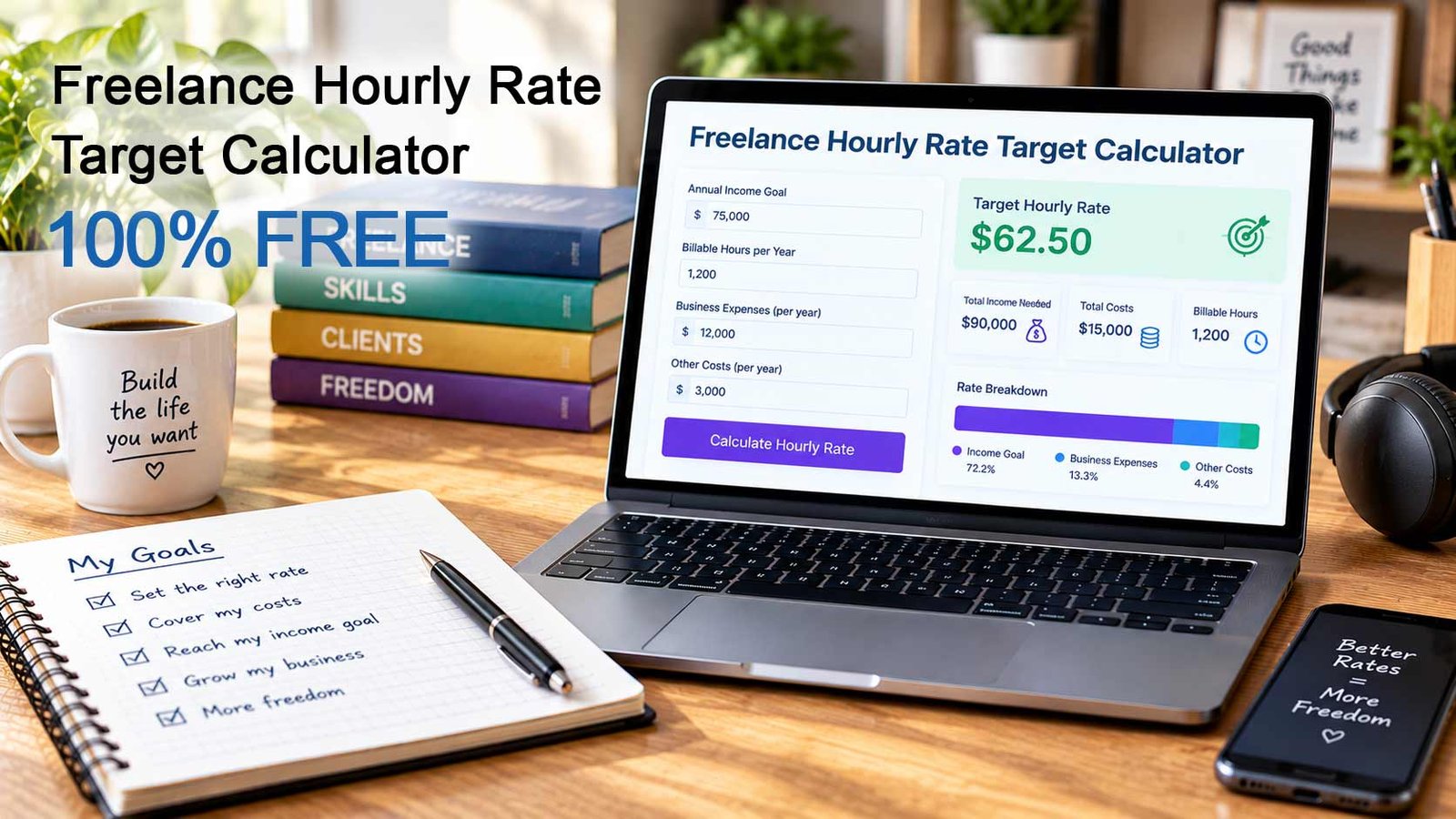
The Freelance Hourly Rate Target Calculator is a free tool that works backward from the income you want to earn and tells you the hourly rate you must charge to reach it. Most freelancers pick a rate by looking at competitors or guessing. This calculator starts with your goal instead. You enter your target take-home salary, your tax rate, your health insurance, your business expenses, and how much of your time is actually billable. The tool then shows the exact rate that covers everything.
A freelancer pays for things an employee never sees: self-employment taxes, health coverage, software, equipment, unpaid vacation, and hours spent on invoices, emails, and finding clients. Ignoring these costs is the most common reason freelancers undercharge. This calculator puts all of them into one number.
Who Is This Calculator For?
The Freelance Hourly Rate Target Calculator is built for independent professionals who sell their time or projects, including:
- Freelance writers, designers, developers, and marketers
- Consultants, coaches, and virtual assistants
- Photographers, videographers, and translators
- Anyone moving from a salaried job to freelancing who needs to know what rate replaces a salary
It also helps experienced freelancers who want to check whether their current rates still support their goals after costs or taxes have gone up.
How to Use the Freelance Hourly Rate Target Calculator
- Enter the annual take-home salary you want to earn.
- Set your estimated tax rate with the slider.
- Enter your monthly health insurance cost.
- Enter your monthly business operating expenses.
- Set the number of hours you work per week.
- Set the share of your time spent on non-billable administrative work.
- Set the number of weeks you take off each year.
- Add a profit and savings buffer if you want a safety margin.
The results update instantly as you move any slider or change any number. The top cards show your required hourly rate and revenue targets. The Calculation breakdown section shows how each part contributes to the final rate.
What Each Input Field Means
Target annual take-home salary
The amount you want to keep each year after taxes. This is your personal income goal, not your total revenue.
Estimated tax rate
The percentage of your pre-tax income that goes to taxes. For freelancers this usually includes income tax plus self-employment or social contributions. If you are unsure, check with your accountant or use a conservative estimate.
Health insurance (per month)
What you pay each month for your own health coverage. Employees often get this paid by an employer, but freelancers must cover it themselves.
Operating expenses (per month)
Your recurring business costs, such as software subscriptions, equipment, coworking space, internet, accounting, marketing, and professional fees.
Hours worked per week
The total hours you plan to work in a normal week, both billable and non-billable.
Non-billable administrative time
The percentage of your working hours that you cannot charge to clients. This covers invoicing, emails, proposals, bookkeeping, and looking for new work. Many freelancers underestimate this and find that 20 to 40 percent of their time is non-billable.
Weeks off per year
The weeks you will not work, including vacation, public holidays, and sick leave. Freelancers are not paid for these weeks, so the cost has to be recovered in the rate.
Profit and savings buffer
An extra percentage added on top of your costs and income needs. It creates room for slow months, emergency savings, retirement contributions, or business growth.
How the Freelance Hourly Rate Is Calculated
The calculator works in four steps. All formulas are shown in plain text so you can follow or check them.
Step 1: Pre-tax income needed
Pre-Tax Income Needed = Target Annual Take-Home Salary divided by 1 minus Tax Rate
The tax rate is used as a decimal. For example, 25 percent becomes 0.25. Estimated Annual Taxes = Pre-Tax Income Needed minus Target Annual Take-Home Salary.
Step 2: Add costs and buffer
Annual Health Insurance = Monthly Health Insurance times 12
Annual Operating Expenses = Monthly Operating Expenses times 12
Subtotal = Pre-Tax Income Needed plus Annual Health Insurance plus Annual Operating Expenses
Profit and Savings Buffer Amount = Subtotal times Buffer Percentage as a decimal
Required Annual Revenue = Subtotal plus Profit and Savings Buffer Amount
Step 3: Calculate billable hours
Working Weeks per Year = 52 minus Weeks Off
Total Hours Worked per Year = Working Weeks per Year times Hours Worked per Week
Billable Hours per Year = Total Hours Worked per Year times 1 minus Non-Billable Percentage as a decimal
Non-Billable Hours per Year = Total Hours Worked per Year minus Billable Hours per Year
Billable Hours per Working Week = Billable Hours per Year divided by Working Weeks per Year
Step 4: Find your rate
Required Hourly Rate = Required Annual Revenue divided by Billable Hours per Year
The calculator also shows these extra figures:
Required Monthly Revenue = Required Annual Revenue divided by 12
Day Rate = Required Hourly Rate times 8
Effective Rate Across All Hours Worked = Required Annual Revenue divided by Total Hours Worked per Year
Example Calculation
Suppose a freelance designer wants a take-home salary of 80,000 dollars. They estimate taxes at 25 percent, pay 400 dollars per month for health insurance and 500 dollars per month in business expenses. They work 40 hours per week, spend 30 percent of that time on non-billable tasks, take 6 weeks off, and add a 10 percent buffer.
- Pre-tax income needed: 80,000 divided by 0.75 = about 106,667 dollars
- Annual health insurance: 4,800 dollars
- Annual operating expenses: 6,000 dollars
- Subtotal: about 117,467 dollars
- Buffer at 10 percent: about 11,747 dollars
- Required annual revenue: about 129,213 dollars
- Working weeks: 52 minus 6 = 46
- Total hours: 46 times 40 = 1,840
- Billable hours: 1,840 times 0.70 = 1,288
- Required hourly rate: 129,213 divided by 1,288 = about 100.32 dollars per hour
The effective rate across all 1,840 hours worked is only about 70.22 dollars. That gap shows why a freelancer needs a higher billable rate than an employee’s hourly pay.
Tips for Using Your Result
- Compare the required rate with your market. If it is higher than what clients in your field pay, you can raise efficiency, lower expenses, cut non-billable time, or move toward higher-value services.
- Use the day rate when quoting daily work, and the monthly revenue figure to set sales targets.
- Review your numbers at least once a year, since taxes, insurance, and costs change.
- Consider switching from hourly pricing to project or retainer pricing once you know your minimum rate. This gives you a floor for every quote.

Gabi is the founder and CEO of Adurbs Networks, a digital marketing company he started in 2016 after years of building web projects.
Beginning as a web designer, he quickly expanded into full-spectrum digital marketing, working on email marketing, SEO, social media, PPC, and affiliate marketing.
Known for a practical, no-fluff approach, Gabi is an expert in PPC Advertising and Amazon Sponsored Ads, helping brands refine campaigns, boost ROI, and stay competitive. He’s also managed affiliate programs from both sides, giving him deep insight into performance marketing.