
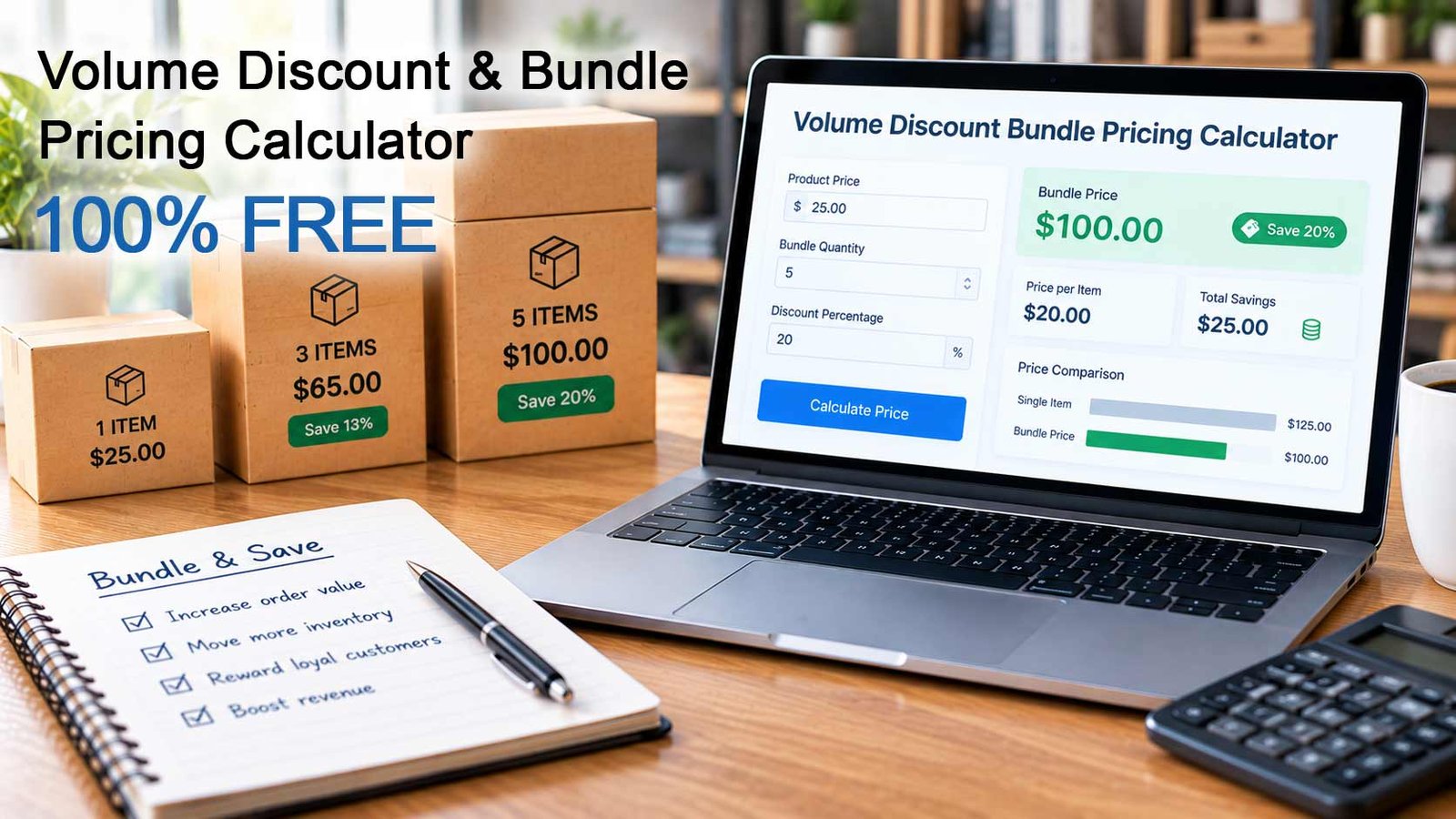
Offering discounts and product bundles is one of the fastest ways to increase sales volume, clear inventory, and boost your average order value (AOV). However, cutting prices without analyzing your margins can quickly erode your business profitability.
Our Volume Discount & Bundle Pricing Calculator is a free tool designed to give ecommerce sellers, brand owners, and marketers real-time clarity on how promotional discounts and bundle deals affect overall bottom-line profits.
What Does the Volume Discount & Bundle Pricing Calculator Do?
When you offer a discount—whether it is 10% off a multi-pack or $15 off a bundle—your profit margin per unit drops. To maintain your baseline monthly income, your sales volume must increase to make up for that lower margin.
This calculator evaluates your promotional strategy before you launch it. It compares your baseline sales data against your promotional offer to show you:
- Your new per-unit profit margin after accounting for cost of goods sold (COGS) and discounts.
- Your exact break-even sales target (the number of units you must sell to avoid losing money compared to your baseline).
- The net profit impact of your campaign, factoring in optional marketing or advertising expenses.
- Your campaign risk level, giving you immediate feedback on whether your sales targets are realistic.
Who Is This Calculator For?
This tool is built specifically for product-based sellers and ecommerce growth strategists, including:
- Ecommerce Store Owners (Shopify, WooCommerce, Amazon): Evaluate volume tiered pricing, “Buy More, Save More” deals, or multi-unit bundles.
- Brand Managers & Marketers: Plan promotional campaigns and ad budgets while ensuring target return on ad spend (ROAS).
- Wholesale & B2B Sellers: Calculate minimum order quantity (MOQ) discount tiers while protecting wholesale gross margins.
- Product Managers: Structure compelling product bundles without squeezing profit margins below sustainable levels.
How to Use the Calculator (Step-by-Step Field Guide)
Using the calculator is simple and takes less than a minute. Here is what each input field represents:
1. Promo Strategy (Toggle)
Select how you want to structure your promotion:
- Tiered Volume Discount: Applies a percentage discount when customers purchase a minimum quantity of a single product.
- Product Bundle Discount: Applies a flat dollar amount discount off a grouped set or multi-item bundle.
2. Regular Unit Selling Price ($)
Enter your standard, full-price selling price for a single unit before any discounts are applied.
3. Unit Cost of Goods Sold / COGS ($)
Enter all direct costs incurred to manufacture or source a single unit. This includes product manufacturing costs, packaging, and unit-level fulfillment costs.
4. Baseline Monthly Sales Volume (Slider)
Set your current average monthly sales volume (in units) at regular full price. This serves as your benchmark for current monthly profit.
5. Promo Marketing / Ad Spend ($ – Optional)
Enter any paid advertising, influencer costs, or promotional spend budgeted to run this campaign. The calculator factors this expense into your break-even requirements.
6. Volume Discount Percentage (%) or Bundle Total Discount ($)
- If using Volume Discount Mode, set the percentage discount off the regular price (e.g., 15% off).
- If using Bundle Discount Mode, enter the flat dollar amount discounted off the entire bundle (e.g., $10 off).
7. Minimum Tier Purchase Quantity / Items Included in Bundle (Slider)
Set the minimum number of units required to qualify for the discount tier or the total number of items contained in the bundle.
Understanding the Calculations and Formulas
Transparency is key when planning pricing strategies. Here is how the calculator computes your results, written in plain text formulas so you can easily replicate them:
1. Baseline Profit Formula
- Baseline Unit Margin = Regular Unit Selling Price minus Unit COGS
- Baseline Monthly Profit = Baseline Unit Margin multiplied by Baseline Monthly Sales Volume
- Baseline Gross Margin Percentage = (Baseline Unit Margin divided by Regular Unit Selling Price) multiplied by 100
2. Promotional Pricing Formulas
- Volume Discount Unit Price = Regular Unit Selling Price minus (Regular Unit Selling Price multiplied by (Discount Percentage divided by 100))
- Bundle Discount Unit Price = ((Regular Unit Selling Price multiplied by Items in Bundle) minus Bundle Dollar Discount) divided by Items in Bundle
- Promotional Unit Margin = Promotional Unit Price minus Unit COGS
- Promotional Gross Margin Percentage = (Promotional Unit Margin divided by Promotional Unit Price) multiplied by 100
3. Target Profit & Break-Even Volume Formulas
- Target Gross Profit = Baseline Monthly Profit plus Promo Marketing Ad Spend
- Break-Even Sales Required (Units) = Target Gross Profit divided by Promotional Unit Margin (result is rounded up to the nearest whole unit)
- Extra Units Required = Break-Even Sales Required minus Baseline Monthly Sales Volume
- Volume Increase Percentage Required = (Extra Units Required divided by Baseline Monthly Sales Volume) multiplied by 100
4. Profit Impact Formula
- Projected Profit Impact = (Break-Even Sales Required multiplied by Promotional Unit Margin) minus Promo Marketing Ad Spend minus Baseline Monthly Profit
3 Tips for Setting Up Profitable Volume & Bundle Pricing
- Always Account for Marketing Costs: Never evaluate a discount in isolation. If you plan to spend $500 on ads to promote a bundle deal, that $500 must be recovered through increased volume before the campaign generates true profit.
- Watch Your Break-Even Volume Jump: If your calculator indicates that you need a +150% jump in sales volume just to break even, your discount may be too steep or your unit COGS too high. Aim for low-to-moderate volume increase targets.
- Encourage Higher Minimum Quantities: If you must offer a larger discount, offset the margin drop by increasing the minimum quantity required. Increasing bundle sizes lets you capture higher overall cart values while spreading fixed costs across more units.

Gabi is the founder and CEO of Adurbs Networks, a digital marketing company he started in 2016 after years of building web projects.
Beginning as a web designer, he quickly expanded into full-spectrum digital marketing, working on email marketing, SEO, social media, PPC, and affiliate marketing.
Known for a practical, no-fluff approach, Gabi is an expert in PPC Advertising and Amazon Sponsored Ads, helping brands refine campaigns, boost ROI, and stay competitive. He’s also managed affiliate programs from both sides, giving him deep insight into performance marketing.