
Turning raw spreadsheets, warehouse tables, and messy logs into clear business decisions used to require writing complex SQL queries, debugging Python scripts, and spending hours formatting charts.
Today, AI data analysis tools let founders, analysts, and operations teams interrogate their datasets in plain English, automate statistical modeling, and generate interactive visualizations in seconds.
Whether you are uploading a quick CSV for trend discovery, querying a live Snowflake warehouse directly from Slack, or orchestrating enterprise machine learning pipelines, artificial intelligence has lowered the technical barrier to deep analytics.
Modern platforms go far beyond basic summaries by writing and executing verifiable code, detecting anomalies automatically, and enforcing governed semantic definitions across teams.
Because different workflows call for either conversational self-service, collaborative notebooks, or scalable cloud data platforms, picking the right tool is essential.
Below, you will find a curated roundup of the leading platforms transforming data analysis today.
The Complete List of 30 AI Data Analysis Tools
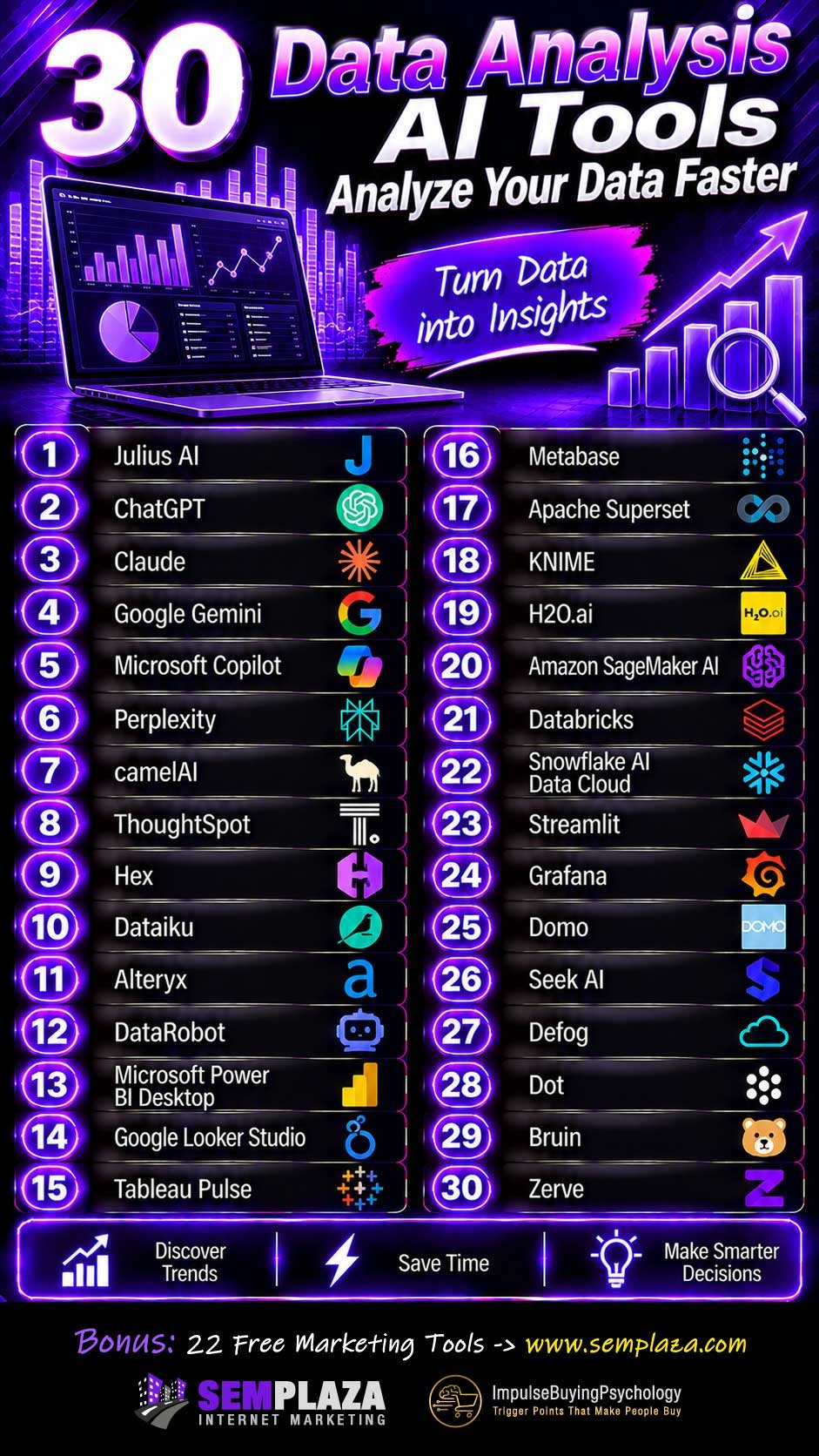
We have organized 30 notable AI data analysis tools below, spanning conversational AI analysts, AI-enhanced business intelligence suites, machine learning platforms, and natural-language-to-SQL engines, so you can easily find the right fit for your stack.
Top AI Data Analysis Tools
- 1. Julius AI – Dedicated AI data analyst that connects to spreadsheets and databases to clean data, run Python and R analyses, and generate downloadable charts.
- 2. ChatGPT – OpenAI’s flagship conversational assistant featuring built-in Python code execution to analyze uploaded spreadsheets, clean datasets, and render interactive charts.
- 3. Claude – Anthropic’s AI assistant equipped with a built-in JavaScript analysis tool and Artifacts to process CSVs, run calculations, and build interactive dashboards.
- 4. Google Gemini – Google’s multimodal AI assistant integrated across Google Workspace and Sheets to analyze tables, generate formulas, and summarize large datasets.
- 5. Microsoft Copilot – AI productivity assistant embedded in Excel and Microsoft 365 to write formulas, generate pivot tables, and uncover trends in spreadsheets.
- 6. Perplexity – AI-powered research and answer engine that combines real-time web retrieval with file analysis to benchmark internal data against market trends.
- 7. camelAI – Natural language data analytics platform that connects directly to SQL databases and spreadsheets to generate instant queries, reports, and interactive Plotly charts.
- 8. ThoughtSpot – Search-driven AI analytics platform featuring SpotIQ to automatically surface anomalies, trends, and plain-language explanations across enterprise data.
- 9. Hex – Collaborative data workspace combining SQL and Python notebooks with an integrated AI assistant for exploratory analysis and interactive data apps.
- 10. Dataiku – Enterprise AI and machine learning platform enabling technical and business teams to prepare data, build predictive models, and deploy analytics workflows.
- 11. Alteryx – Self-service data preparation and analytics automation platform enhanced with generative AI to streamline blending, spatial analytics, and predictive modeling.
- 12. DataRobot – Enterprise AI platform focused on automated machine learning, predictive analytics, and governed generative AI workflows for structured business data.
- 13. Microsoft Power BI Desktop – Business intelligence authoring tool enhanced with Copilot to generate DAX queries, build report pages, and summarize visual insights.
- 14. Google Looker Studio – Free browser-based business intelligence and reporting tool that connects to BigQuery, Google Sheets, and marketing sources for interactive dashboards.
- 15. Tableau Pulse – AI-powered insights experience within Tableau that delivers automated, personalized metric digests and plain-language explanations of KPI changes.

More AI Data Analysis Tools to Try
- 16. Metabase – Open-source business intelligence platform featuring an intuitive visual query builder and AI assistance for self-serve dashboards and SQL exploration.
- 17. Apache Superset – Open-source data exploration and visualization platform designed to handle high-scale modern SQL databases with rich interactive dashboards.
- 18. KNIME – Open-source visual workflow platform for data science and analytics that pairs drag-and-drop data blending with an integrated AI assistant.
- 19. H2O.ai – Open-source and enterprise predictive and generative AI platform specializing in automated machine learning and scalable model deployment.
- 20. Amazon SageMaker AI – Comprehensive AWS cloud platform for building, training, and deploying custom machine learning models and data science notebooks at scale.
- 21. Databricks – Unified data intelligence platform combining lakehouse storage, Apache Spark processing, and natural language AI assistants for large-scale analytics.
- 22. Snowflake AI Data Cloud – Cloud data platform integrating Cortex AI features to let teams run LLM functions, natural language queries, and ML models directly on governed data.
- 23. Streamlit – Open-source Python framework that lets data scientists rapidly turn analysis scripts and LLM workflows into shareable interactive web apps.
- 24. Grafana – Open-source observability and time-series visualization platform enhanced with AI features to analyze metrics, logs, and operational anomalies.
- 25. Domo – Cloud-native business intelligence and data integration platform incorporating AI assistants for automated reporting, forecasting, and alerts.
- 26. Seek AI – Enterprise natural-language-to-SQL platform backed by custom semantic modeling that enables business users to query data warehouses via web or Slack.
- 27. Defog – Privacy-focused text-to-SQL engine powered by fine-tuned SQLCoder models to translate plain-English questions into accurate warehouse queries.
- 28. Dot – Chat-native AI data analyst built for Slack and Microsoft Teams that answers business questions using a governed semantic layer on top of your warehouse.
- 29. Bruin – Open-source data pipeline platform paired with a multi-channel AI data analyst that handles ingestion, transformations, quality checks, and natural language queries.
- 30. Zerve – Agentic data science development environment that unifies Python, SQL, and R in a reproducible canvas with parallel compute and instant API deployment.
Using this list as a starting point, you can match your analytics goals with the right AI data analysis tool, whether you are exploring a single spreadsheet, enabling self-serve metrics in Slack, or scaling enterprise machine learning pipelines. Because each platform offers different strengths in governance, code transparency, and database connectivity, testing a few options on your real datasets will help you uncover faster, more reliable insights.
Share this infographic on your site:

Gabi is the founder and CEO of Adurbs Networks, a digital marketing company he started in 2016 after years of building web projects.
Beginning as a web designer, he quickly expanded into full-spectrum digital marketing, working on email marketing, SEO, social media, PPC, and affiliate marketing.
Known for a practical, no-fluff approach, Gabi is an expert in PPC Advertising and Amazon Sponsored Ads, helping brands refine campaigns, boost ROI, and stay competitive. He’s also managed affiliate programs from both sides, giving him deep insight into performance marketing.