
Automating complex business processes used to require rigid if-this-then-that rules, fragile custom webhooks, and constant manual oversight whenever an edge case appeared.
Today, AI agents for workflow automation combine large language models with memory, reasoning, and direct tool access to plan and execute multi-step tasks autonomously.
Whether you are triaging customer support tickets, enriching CRM leads, orchestrating multi-agent research pipelines, or letting an agent navigate browser interfaces directly, autonomous workflows adapt dynamically to unstructured inputs.
Modern platforms span everything from visual no-code builders that connect thousands of SaaS apps to developer-first frameworks for stateful multi-agent orchestration and computer-use agents.
Because each solution balances ease of setup, custom code flexibility, and enterprise governance differently, selecting the right platform is crucial.
Below, you will find a list of the leading platforms powering automated agentic workflows today.
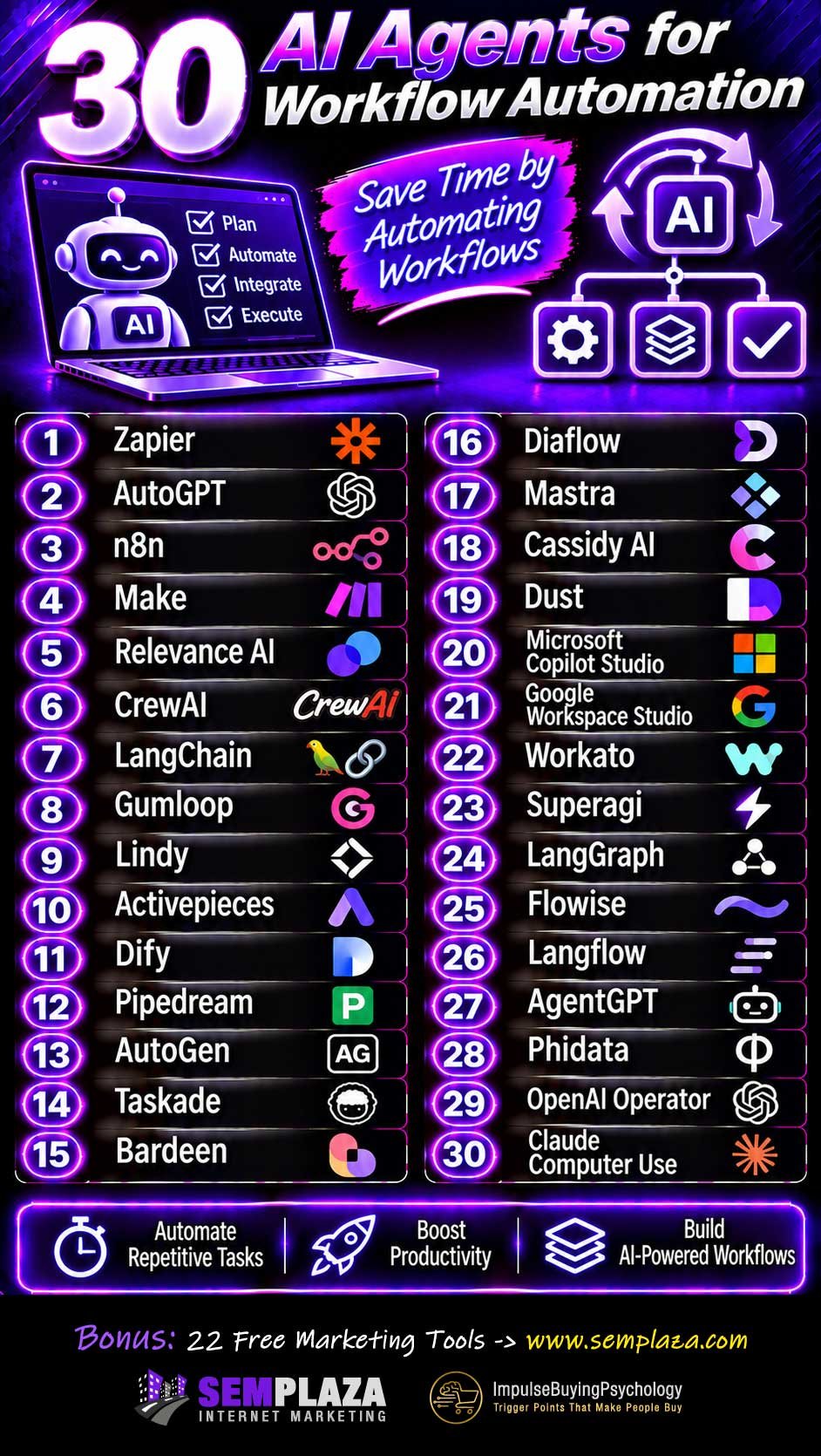
The Complete List of 30 AI Agents for Workflow Automation
We have organized 30 notable AI agents for workflow automation below, spanning no-code visual automation suites, open-source multi-agent frameworks, enterprise copilot studios, and computer-use agents, so you can easily find the best fit for your stack.
Top AI Agents for Workflow Automation
- 1. Zapier – No-code automation leader offering Zapier Agents so non-technical teams can build autonomous AI helpers across thousands of connected business apps.
- 2. AutoGPT – Pioneering open-source autonomous AI agent project designed to break high-level goals into subtasks, browse the web, and execute multi-step workflows.
- 3. n8n – Source-available visual workflow automation platform with native LangChain nodes and self-hosting options for building multi-provider AI agents and human-in-the-loop approvals.
- 4. Make – Visual drag-and-drop automation canvas featuring built-in Make AI Agents with transparent step-by-step reasoning panels for multi-app business workflows.
- 5. Relevance AI – No-code AI workforce platform enabling teams to build, customize, and deploy multi-agent teams equipped with business tools and CRM integrations.
- 6. CrewAI – Popular Python framework and enterprise platform for orchestrating collaborative, role-playing AI agents that delegate and complete complex workflows together.
- 7. LangChain – Foundational open-source framework providing modular abstractions, tool integrations, and memory components to build context-aware LLM agents and applications.
- 8. Gumloop – Visual drag-and-drop AI automation platform that lets teams connect web scrapers, LLMs, and SaaS tools into repeatable, no-code agentic workflows.
- 9. Lindy – No-code AI assistant builder designed to automate email triage, meeting scheduling, CRM updates, and cross-app administrative workflows.
- 10. Activepieces – Open-source, no-code business automation platform featuring visual AI agent builders and extensible TypeScript integrations for self-hosted or cloud workflows.
- 11. Dify – Open-source LLM app development platform uniting visual agentic workflow orchestration, RAG pipelines, model management, and observability in one studio.
- 12. Pipedream – Developer-friendly integration and workflow platform combining managed authentication across thousands of APIs with serverless Node.js and Python AI steps.
- 13. AutoGen – Open-source framework created by Microsoft Research for building conversational, multi-agent systems that collaborate with humans and execute code to solve tasks.
- 14. Taskade – Collaborative AI workspace where teams build autonomous AI agents, automated task workflows, and shared knowledge bases in a unified project environment.
- 15. Bardeen – Browser-based AI automation assistant that captures web data, automates repetitive SaaS actions, and connects browser workflows to business apps.

More AI Agents to Try
- 16. Diaflow – Unified AI workspace and workflow automation layer connecting business data, team collaboration, and autonomous AI agents across existing software stacks.
- 17. Mastra – Open-source TypeScript agent framework built for JavaScript developers to create stateful AI workflows, tool integrations, and structured agent pipelines.
- 18. Cassidy AI – No-code business automation platform that connects company knowledge bases and live workplace apps to power context-aware AI assistants and workflows.
- 19. Dust – Enterprise AI agent platform allowing teams to build custom assistants grounded in internal company data across Slack, Notion, Google Drive, and GitHub.
- 20. Microsoft Copilot Studio – Low-code graphical studio for building, customizing, and governing autonomous AI agents integrated across Microsoft 365 and enterprise systems.
- 21. Google Workspace Studio – No-code workflow automation environment powered by Gemini that lets users describe processes in plain language to create agents across Google Workspace apps.
- 22. Workato – Enterprise orchestration and iPaaS platform integrating AI agents and Workato Genie to automate complex, governed workflows across business departments.
- 23. Superagi – Open-source autonomous AI agent framework and infrastructure suite providing GUI management, vector memory, and performance telemetry for running agents.
- 24. LangGraph – Low-level orchestration framework from the LangChain ecosystem built for designing stateful, cyclical, and controllable multi-agent workflows with human oversight.
- 25. Flowise – Open-source drag-and-drop visual UI builder on top of LangChain and LlamaIndex for rapidly prototyping and deploying LLM orchestration flows and agents.
- 26. Langflow – Open-source visual low-code IDE enabling developers to design, test, and expose multi-agent RAG and tool-calling workflows as APIs.
- 27. AgentGPT – Browser-based autonomous AI agent platform allowing users to configure, name, and deploy goal-driven web agents directly from a web interface.
- 28. Phidata – Open-source framework (now known as Agno) for building fast, multimodal AI agents equipped with memory, knowledge bases, and structured tool execution.
- 29. OpenAI Operator – OpenAI’s web-browsing computer-use agent capable of navigating websites, filling forms, and completing multi-step browser tasks autonomously.
- 30. Claude Computer Use – Anthropic’s agentic capability that enables Claude to view screens, move a virtual cursor, type text, and operate desktop or browser applications.
Using this list as a starting point, you can pair your operational bottlenecks with the right AI agents for workflow automation, whether you want visual no-code app integrations, stateful Python and TypeScript orchestration, or autonomous browser execution. Because each platform balances autonomy, human-in-the-loop guardrails, and technical control differently, piloting a few candidates on a repetitive daily process will help you scale productivity reliably.
Share this infographic on your site:

Gabi is the founder and CEO of Adurbs Networks, a digital marketing company he started in 2016 after years of building web projects.
Beginning as a web designer, he quickly expanded into full-spectrum digital marketing, working on email marketing, SEO, social media, PPC, and affiliate marketing.
Known for a practical, no-fluff approach, Gabi is an expert in PPC Advertising and Amazon Sponsored Ads, helping brands refine campaigns, boost ROI, and stay competitive. He’s also managed affiliate programs from both sides, giving him deep insight into performance marketing.