
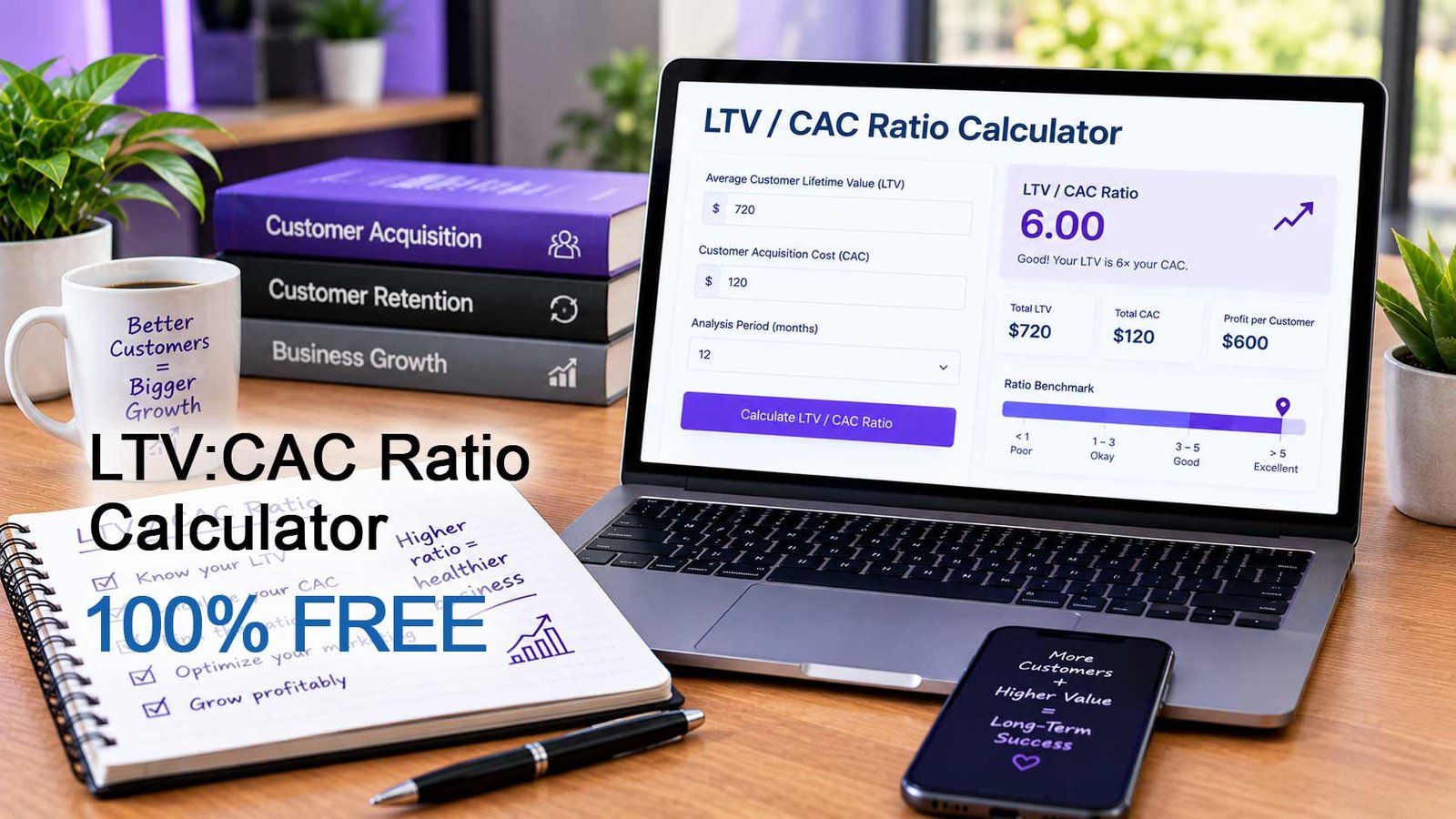
Growing a service business is not only about winning more clients. It is about winning clients who are worth more than they cost to acquire. Our free LTV:CAC Ratio Calculator shows you, in seconds, whether your client acquisition is profitable and sustainable.
What is the LTV:CAC ratio?
The LTV:CAC ratio compares two numbers:
- LTV (Customer Lifetime Value): the total gross profit a client brings to your business over the whole time they work with you.
- CAC (Customer Acquisition Cost): the average amount you spend on marketing, sales and related activities to win one new client.
Dividing LTV by CAC tells you how many dollars of lifetime gross profit you earn for every dollar spent on acquisition. A widely used benchmark is 3:1, meaning each client generates three times what it cost to acquire them. A ratio below 3:1 suggests acquisition is too expensive or clients leave too soon. A ratio far above 5:1 can mean you are underinvesting in growth.
What does this calculator do?
The LTV:CAC Ratio Calculator evaluates your unit economics and long-term business health. Based on your costs, client value, margins and retention, it calculates:
- Your LTV:CAC ratio
- Your customer lifetime value
- Your customer acquisition cost
- Your CAC payback period, which is how many months it takes to earn back the cost of winning a client
- The maximum CAC you can afford while keeping a 3:1 ratio
- The LTV you would need to reach a 3:1 ratio at your current CAC
- A simple health status that tells you where you stand
Who is this calculator for?
The calculator is built for service businesses that earn recurring or project-based revenue from clients, including:
- Marketing, SEO, PPC and creative agencies
- Consultants and coaches
- IT and managed service providers
- Accounting, legal and financial service firms
- Freelancers and small studios
- Any business that sells retainers, subscriptions or ongoing services
Owners, agency founders, sales and marketing managers and finance teams can use it to plan budgets, set pricing, evaluate channels and prepare for investor or board conversations.
How to use the calculator
- Enter your monthly acquisition costs: marketing and advertising spend, sales team cost, and any other acquisition costs.
- Set the number of new clients you win per month with the slider.
- Enter the average monthly revenue per client and any one-time setup or onboarding fee.
- Set your gross margin and the average client lifetime in months with the sliders.
- Read your results instantly. The calculator updates every time you change a value.
Tip: Try changing one input at a time. Raising client lifetime, improving gross margin or reducing acquisition spend are the three fastest ways to improve your ratio, and the calculator shows the impact immediately.
What each input field means
Marketing and advertising spend (monthly). Everything you spend each month to attract leads, such as paid ads, content, SEO, email tools and sponsorships.
Sales team cost (salaries and commissions). The monthly cost of the people who convert leads into clients, including salaries, commissions and bonuses for sales staff or business development.
Other acquisition costs. Any additional monthly costs linked to winning clients, such as CRM and sales software, events, referral payments and proposal tools.
New clients won per month. The average number of new paying clients you gain in a month. This is used to work out the cost of acquiring a single client.
Average monthly revenue per client. What a typical client pays you each month, for example a retainer or recurring fee.
One-time setup or onboarding fee. Any single payment charged at the start of the relationship, such as a setup, audit or onboarding fee. Leave it at zero if you do not charge one.
Gross margin. The percentage of revenue left after the direct costs of delivering your service, such as staff time, contractors and software used for client work. A higher margin means more of each dollar becomes profit.
Average client lifetime. The average number of months a client stays with you. You can estimate it by dividing one by your monthly client churn rate, or by looking at how long past clients have stayed.
How the calculations work
All formulas are shown in plain text so you can follow every step.
Total monthly acquisition cost
Total Monthly Acquisition Cost equals Marketing and Advertising Spend plus Sales Team Cost plus Other Acquisition Costs.
Customer acquisition cost (CAC)
CAC equals Total Monthly Acquisition Cost divided by New Clients Won per Month.
Lifetime revenue per client
Lifetime Revenue per Client equals Average Monthly Revenue multiplied by Average Client Lifetime in months, plus the One-Time Setup Fee.
Gross profit per client per month
Monthly Gross Profit per Client equals Average Monthly Revenue multiplied by Gross Margin.
Customer lifetime value (LTV)
LTV equals Lifetime Revenue per Client multiplied by Gross Margin.
LTV:CAC ratio
LTV:CAC Ratio equals LTV divided by CAC. The result is shown as a number to one, for example 3.2 to 1.
CAC payback period
CAC Payback Period in months equals CAC minus the gross profit from the Setup Fee, divided by Monthly Gross Profit per Client.
Net profit per client after acquisition cost
Net Profit per Client equals LTV minus CAC.
Maximum CAC for a 3:1 ratio
Maximum CAC equals LTV divided by 3.
LTV needed for a 3:1 ratio
Required LTV equals CAC multiplied by 3.
Example
Imagine a digital agency that spends 4,000 dollars a month on marketing, 3,000 dollars on sales and 1,000 dollars on other acquisition costs, and wins 8 new clients a month. Each client pays 600 dollars a month plus a 400 dollar setup fee, the gross margin is 50 percent, and clients stay for 10 months on average.
- Total Monthly Acquisition Cost equals 8,000 dollars.
- CAC equals 8,000 divided by 8, which is 1,000 dollars.
- Lifetime Revenue per Client equals 600 multiplied by 10, plus 400, which is 6,400 dollars.
- LTV equals 6,400 multiplied by 0.5, which is 3,200 dollars.
- LTV:CAC Ratio equals 3,200 divided by 1,000, which is 3.2 to 1.
- Monthly Gross Profit per Client equals 600 multiplied by 0.5, which is 300 dollars.
- CAC Payback Period equals 1,000 minus 200, divided by 300, which is about 2.7 months.
This agency is above the 3:1 target. To stay there, it should keep CAC under about 1,067 dollars.
How to read your results
- Below 1:1: you lose money on every client. Reduce acquisition costs, raise prices or improve retention urgently.
- Between 1:1 and 3:1: you are profitable on paper but below the healthy target. Improve margins, retention or channel efficiency.
- Between 3:1 and 5:1: healthy unit economics for most service businesses.
- Above 5:1: very strong. You may have room to invest more in marketing and sales to grow faster.
Also check the CAC payback period. Shorter payback means faster cash recovery and less risk, which matters especially for agencies with limited cash flow.
How to improve your LTV:CAC ratio
- Increase client lifetime by improving onboarding, reporting and account management.
- Raise average revenue per client through upsells, cross-sells and price reviews.
- Improve gross margin by streamlining delivery, automating tasks and managing contractor costs.
- Reduce CAC by focusing on higher-converting channels, referrals and better lead qualification.
- Charge a setup or onboarding fee to recover part of your acquisition cost faster.
Limitations
This calculator provides estimates based on the numbers you enter. It does not include discounting, taxes, overhead, refunds or changes in pricing over time, and it uses averages that may hide differences between client segments. Use it as a planning and decision-making tool, and review your inputs regularly with real data.

Gabi is the founder and CEO of Adurbs Networks, a digital marketing company he started in 2016 after years of building web projects.
Beginning as a web designer, he quickly expanded into full-spectrum digital marketing, working on email marketing, SEO, social media, PPC, and affiliate marketing.
Known for a practical, no-fluff approach, Gabi is an expert in PPC Advertising and Amazon Sponsored Ads, helping brands refine campaigns, boost ROI, and stay competitive. He’s also managed affiliate programs from both sides, giving him deep insight into performance marketing.