
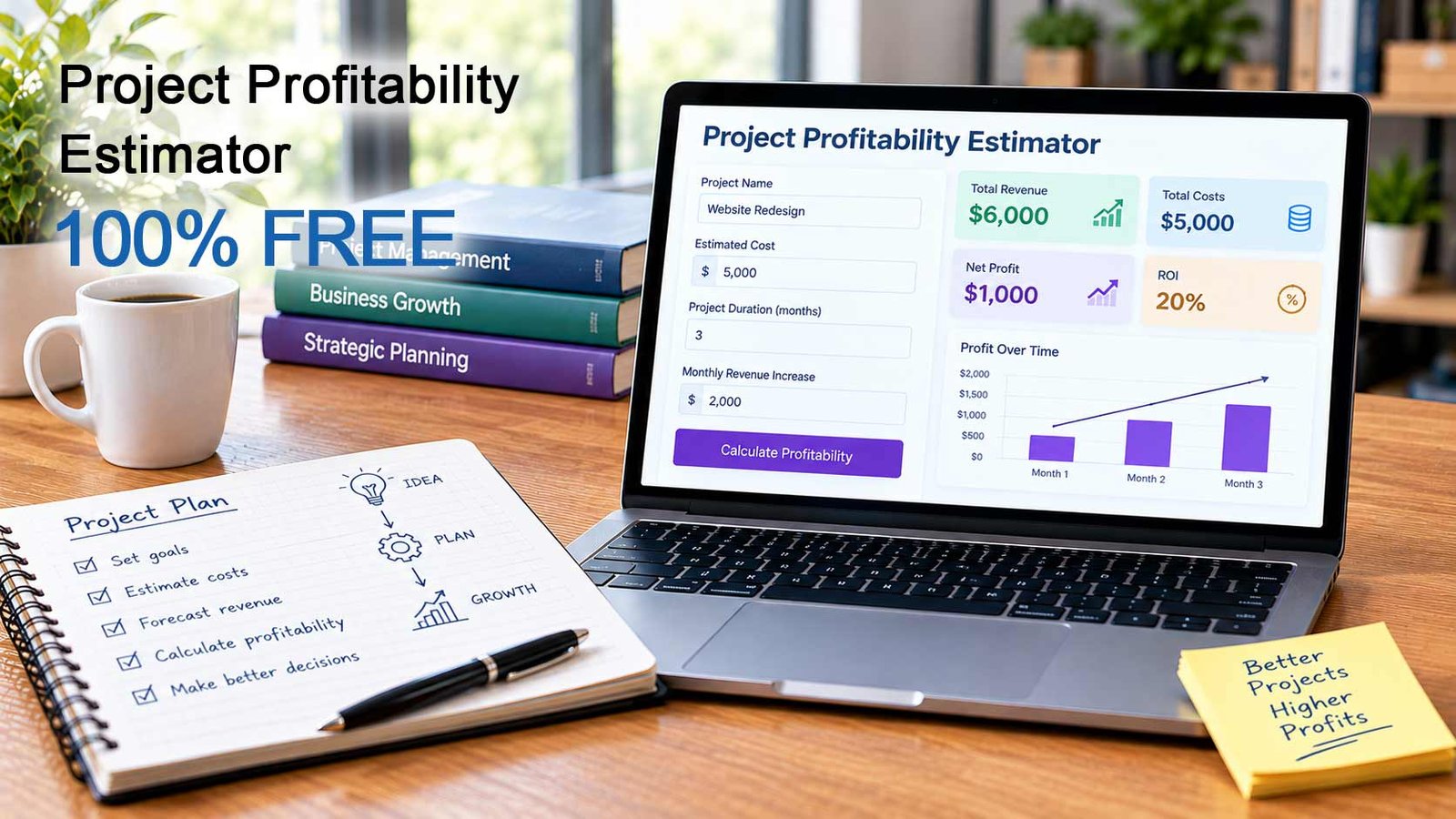
Accurately pricing service-based work is one of the most critical challenges agency owners, freelancers, and project managers face. Delivering exceptional work means little if hidden costs and uncalculated labor hours consume your profit margins.
Our interactive Project Profitability Estimator solves this problem by providing a real-time, comprehensive breakdown of project finances. It helps you calculate precise direct labor costs, overhead allocations, and direct pass-through expenses so you can quote projects with confidence and protect your bottom line.
Who Is This Tool Designed For?
This calculator is tailored specifically for service-based professionals and businesses, including:
- Digital & Creative Agencies: Marketing, web development, SEO, and design agencies looking to price fixed-fee proposals or retainer agreements accurately.
- Freelancers & Solopreneurs: Independent contractors wanting to determine their effective hourly rate and avoid undercharging for multi-week projects.
- IT & Software Consultants: Firms tracking multi-role billable team hours alongside software licensing and infrastructure costs.
- Project Managers & Operations Leads: Professionals tasked with forecasting project profitability before presenting scopes of work to stakeholders or clients.
How to Use the Project Profitability Estimator
Using the estimator takes only a few simple steps:
1. Enter Project Details
Input your client name, select your billing structure (Fixed Fee, Time & Materials, or Monthly Retainer), and type in the expected revenue.
2. Define Team Roles & Rates
Add each team member contributing to the project, specify their expected hours, and enter their internal hourly cost rate.
3. Include Overhead & Expenses
Account for indirect company overheads (as a percentage of revenue or a fixed dollar amount) and add pass-through project expenses.
4. Set Your Target Margin Goal
Adjust the Target Gross Profit Margin slider to compare your project performance against internal financial targets.
5. Review Real-Time Output Metrics
Instantly evaluate your gross profit, net profit, break-even threshold, and interactive breakdown charts.
Guide to Input Fields and Definitions
To ensure accurate calculations, here is an explanation of what each field represents:
- Client / Project Name: An identifier for your record keeping and printed reports.
- Billing Model: The pricing agreement used for the client (Fixed Fee, Time & Materials, or Monthly Retainer).
- Total Revenue ($): The total agreed amount charged or billed to the client for the project.
- Role / Member: The title or individual team member working on the deliverables (e.g., Senior Developer, Designer, Project Manager).
- Hours: The total estimated hours a specific team member will dedicate to the project.
- Cost Rate ($/h): The internal hourly cost to your company for that team member. This should reflect base salary or contractor pay plus employee benefits and taxes.
- Overhead Calculation: Indirect operating expenses such as office space, administrative salaries, and software subscriptions. This can be calculated as a fixed dollar amount or as a percentage of total project revenue.
- Pass-Through / Software Expenses: Direct third-party expenses paid exclusively for this project, such as domain names, stock photos, theme licenses, or external contractor fees.
- Target Gross Profit Margin Goal (%): Your desired benchmark profit percentage, used to evaluate whether the project meets company financial goals.
How Calculations Are Made (Plain Text Formulas)
Understanding how your profit metrics are calculated allows you to make better strategic pricing decisions. All formulas used by the estimator are detailed below in standard text format.
1. Individual Team Member Labor Cost
To find the cost of each team member, multiply their logged hours by their internal hourly cost rate:
Team Member Cost = Hours multiplied by Cost Rate
2. Total Direct Labor Cost
The sum of all individual team member labor costs:
Total Labor Cost = Sum of all individual Team Member Costs
3. Total Direct Expenses
The sum of all pass-through project costs:
Total Expenses = Sum of all individual Pass Through Expenses
4. Overhead Allocation Cost
If using percentage based overhead:
Overhead Cost = Total Revenue multiplied by Overhead Percentage divided by 100
If using fixed overhead:
Overhead Cost = Fixed Overhead Value
5. Total Project Cost
The total expenditure required to deliver the project:
Total Cost = Total Labor Cost plus Overhead Cost plus Total Expenses
6. Gross Profit & Gross Profit Margin
Gross profit represents revenue remaining after subtracting direct labor costs:
Gross Profit = Total Revenue minus Total Labor Cost
Gross Margin Percentage = (Gross Profit divided by Total Revenue) multiplied by 100
7. Net Profit & Net Profit Margin
Net profit represents true profitability after accounting for labor, overhead, and direct expenses:
Net Profit = Total Revenue minus Total Cost
Net Margin Percentage = (Net Profit divided by Total Revenue) multiplied by 100
8. Effective Hourly Rate
The total revenue earned relative to total team labor hours spent:
Effective Hourly Rate = Total Revenue divided by Total Project Hours
9. Break-Even Revenue Threshold
The minimum revenue required to avoid losing money on the project:
Break Even Revenue = Total Cost
10. Required Revenue for Target Margin
The total revenue needed to achieve your target profit percentage given your current project costs:
Required Target Revenue = Total Cost divided by (1 minus (Target Margin Percentage divided by 100))
Take Control of Your Pricing Strategy
By using the Project Profitability Estimator before finalizing proposals, you eliminate guesswork, protect your team from scope creep, and ensure every contract contributes positively to your long-term profit.

Gabi is the founder and CEO of Adurbs Networks, a digital marketing company he started in 2016 after years of building web projects.
Beginning as a web designer, he quickly expanded into full-spectrum digital marketing, working on email marketing, SEO, social media, PPC, and affiliate marketing.
Known for a practical, no-fluff approach, Gabi is an expert in PPC Advertising and Amazon Sponsored Ads, helping brands refine campaigns, boost ROI, and stay competitive. He’s also managed affiliate programs from both sides, giving him deep insight into performance marketing.