
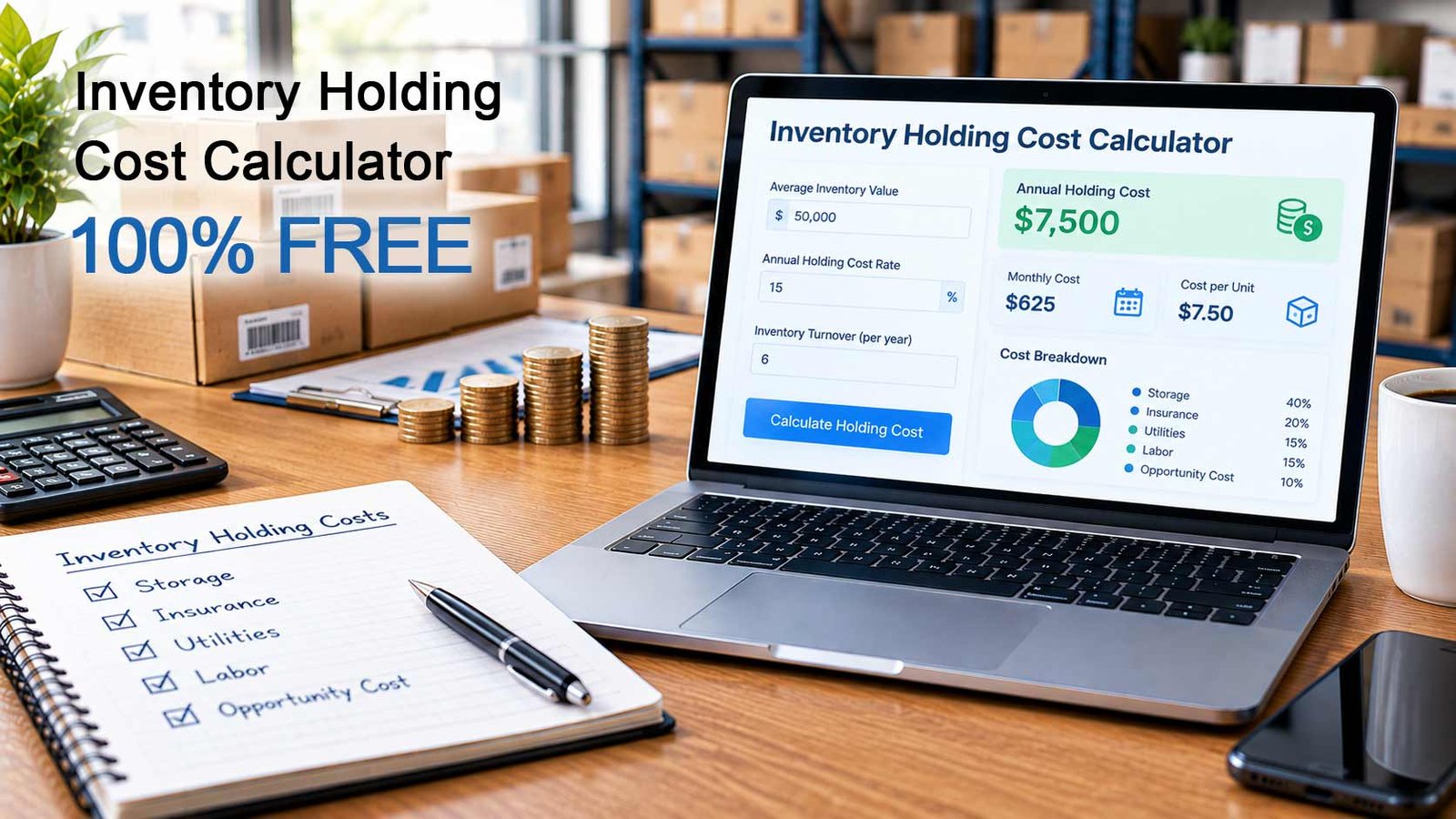
If you run an eCommerce business, a retail storefront, or a wholesale distribution company, inventory is likely your largest asset—and your biggest hidden money pit. Many sellers only look at the initial purchase price of their goods, ignoring the ongoing expenses required to keep products sitting on shelves.
To maintain healthy profit margins, you need to understand your true carrying costs. Our free Inventory Holding Cost Calculator is designed to help you instantly uncover these expenses, evaluate your capital efficiency, and make smarter purchasing and warehousing decisions.
What is the Inventory Holding Cost Calculator?
The Inventory Holding Cost Calculator is a free, user-friendly financial tool that quantifies the total annual cost of storing unsold products relative to your overall inventory volume. It looks beyond simple warehouse rent to factor in risk, shrinkage, depreciation, and the cost of capital tied up in stock.
By running these numbers, you can determine how much of your capital is being eaten away by unsold inventory each year and each month.
Who is This Calculator Targeted To?
This tool is built specifically for:
- eCommerce Sellers: Amazon FBA, Shopify, and WooCommerce store owners managing physical products and warehouse or 3PL fees.
- Retailers and Wholesalers: Business owners managing rotating stock levels, seasonal inventory, and physical retail storage rooms.
- Supply Chain and Operations Managers: Professionals looking to optimize inventory turnover speed, reduce waste, and present accurate holding costs to leadership.
How to Use the Calculator
Using the calculator takes less than a minute. Simply follow these steps:
1. Enter your total inventory value
Input the total monetary value of the stock you currently hold.
2. Input direct fixed expenses
Fill in your annual warehouse or storage facility costs and your annual insurance premiums.
3. Adjust the risk and capital sliders
Slide the percentages for shrinkage, depreciation, and opportunity cost based on your historical data or industry averages.
4. Review your results
Instantly analyze your total annual carrying cost, monthly breakdown, and percentage impact right on the screen.
Understanding the Fields and Inputs
To get the most accurate results, it helps to understand what each field represents:
- Total Inventory Value ($): The total financial value of all unsold stock currently held in your warehouse, fulfillment center, or retail storage.
- Annual Warehouse/Storage Cost ($): The total yearly expense paid for leasing, renting, or operating your storage space (including 3PL storage fees if applicable).
- Annual Insurance Cost ($): The yearly premium paid to insure your inventory against fire, theft, floods, or other disasters.
- Shrinkage/Damage (%): The estimated percentage of inventory lost each year due to employee theft, administrative errors, supplier shortages, or physical damage.
- Depreciation/Obsolescence (%): The percentage by which your inventory loses value over time due to product aging, expiring shelf-lives, changing trends, or technology shifts.
- Opportunity Cost (%): The cost of capital. This represents the return you could have generated if the cash tied up in unsold inventory had been invested elsewhere in your business or financial markets.
How the Calculations Are Made (Formulas)
To ensure complete transparency, here are the exact formulas used behind the scenes to generate your results. All formulas are written in standard plain text for easy publishing in WordPress:
- Shrinkage Dollar Amount: Total Inventory Value multiplied by (Shrinkage Percentage divided by 100)
- Depreciation Dollar Amount: Total Inventory Value multiplied by (Depreciation Percentage divided by 100)
- Opportunity Cost Dollar Amount: Total Inventory Value multiplied by (Opportunity Cost Percentage divided by 100)
- Total Annual Carrying Cost: Annual Warehouse Cost plus Annual Insurance Cost plus Shrinkage Dollar Amount plus Depreciation Dollar Amount plus Opportunity Cost Dollar Amount
- Carrying Cost as Percentage of Inventory: (Total Annual Carrying Cost divided by Total Inventory Value) multiplied by 100
- Monthly Carrying Cost: Total Annual Carrying Cost divided by 12

Gabi is the founder and CEO of Adurbs Networks, a digital marketing company he started in 2016 after years of building web projects.
Beginning as a web designer, he quickly expanded into full-spectrum digital marketing, working on email marketing, SEO, social media, PPC, and affiliate marketing.
Known for a practical, no-fluff approach, Gabi is an expert in PPC Advertising and Amazon Sponsored Ads, helping brands refine campaigns, boost ROI, and stay competitive. He’s also managed affiliate programs from both sides, giving him deep insight into performance marketing.